

Our Supporters
Inside Legal Aid

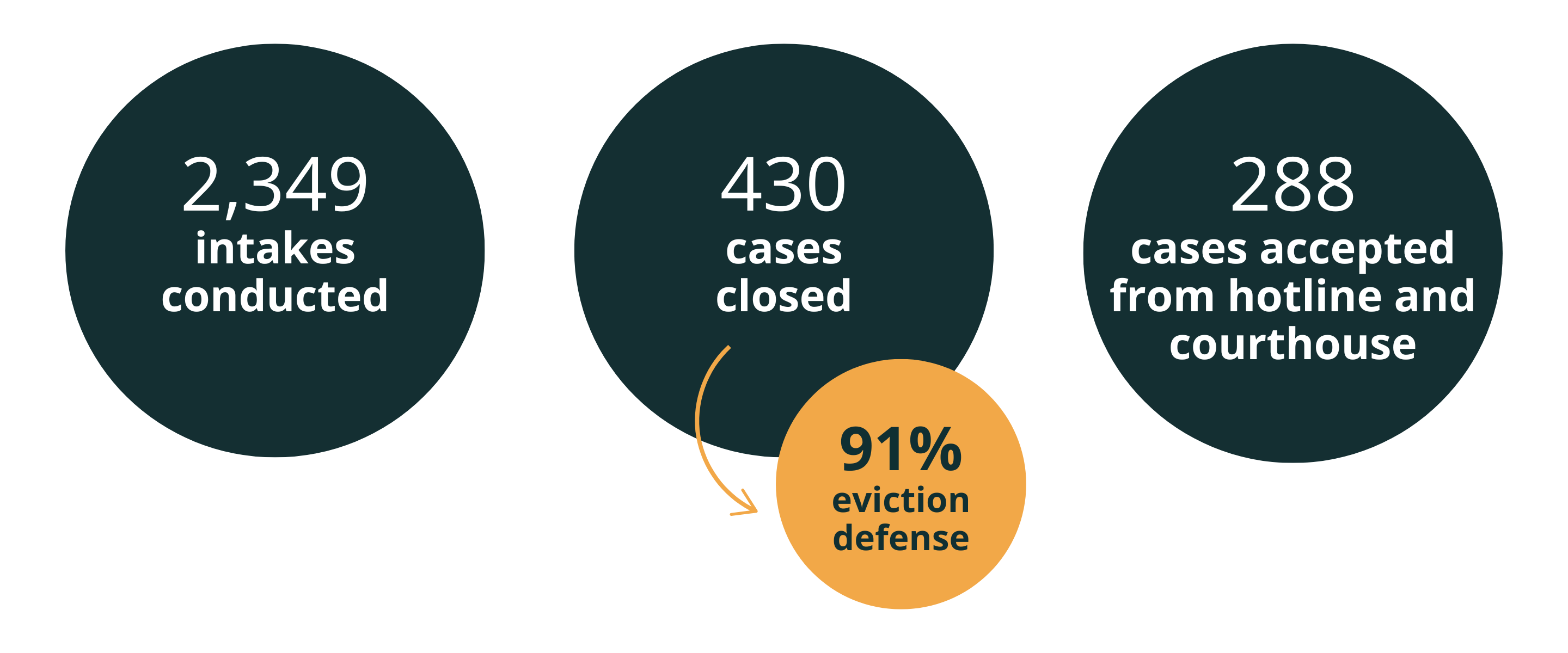
Legal Aid DC’s Housing Law Unit saw a 54% increase in intakes for evictions this year — a reflection of the growing number of families struggling to maintain their housing.
Legal Aid’s housing attorneys helped hundreds of clients facing the loss of their housing, closing 393 eviction defense cases over the last year.
Name
Title
Name
Title
Name
Title
Name
Title
Still, too few tenants have legal counsel as they navigate the complex eviction proceedings. And sometimes, like in the case of Ricky McComb, clients wind up in court because of extensive problems within DC’s housing assistance programs.
Legal Aid’s housing team works to prevent clients like Mr. McComb from falling into the devastating cycle an eviction can cause. Legal Aid staffs the Landlord-Tenant Legal Assistance Network phone hotline five days a week and the courthouse office two days a week to offer representation and advice to as many low-income residents as possible.
Legal Aid’s client community is hit the hardest when budget cuts and policy changes affect the housing programs many rely on. This was especially true this year for the Emergency Rental Assistance Program (ERAP), which helps tenants in crisis who are falling behind on rent and at risk of eviction.
In June, the DC government passed a budget that slashed ERAP’s budget by more than half. Now, the DC Council has also added new restrictions to the program and stripped protections from evictions for tenants seeking the program’s help.
Throughout this uphill battle, Legal Aid’s Housing Law team has worked side-by-side with our client community and partner organizations to advocate for stronger rental assistance for families who often have to make impossible choices between paying rent and putting food on the table.
In the past few months, Legal Aid staff have testified before the DC Council, met with Councilmembers, collaborated with advocacy partners, shared information with tenants, and organized a town hall with residents in Ward 8. Emergency rental assistance will continue to be one of our top housing policy priorities in 2025, and our eviction defense work will become even more critical if tenants seeking ERAP are facing a bigger fight to keep their housing.

“Melanie was the only person in my corner. Before Legal Aid, I felt backed up against the wall. He had the most precious thing in the world against me and I would do anything to see him. Now we’re reunited and I’m not going to let anything break us apart.”
Client Spotlight

Ricky McComb was thrilled when he received the keys to his first apartment: After experiencing homelessness on and off for most of his life, Mr. McComb felt fortunate when he was able to find a place of his own through the D.C. Rapid Rehousing program.
“It was my first apartment ever in my life, so I’m thinking everything is good,” he recalled. “I’m thinking I’m living stable.”
But that feeling of stability didn’t last: Mr. McComb found that his basement apartment had severe mold issues, backed-up plumbing, and a damaged ceiling from a water leak on the floor above. Still, he was so grateful to have any roof over his head, he said, that he felt reluctant to complain too loudly.
After about two years of living in the apartment, he learned he was facing eviction. Mr. McComb’s landlord claimed that he owed over $20,000 — a shocking amount that didn’t square with the assistance Mr. McComb was receiving to cover a portion of his rent each month.